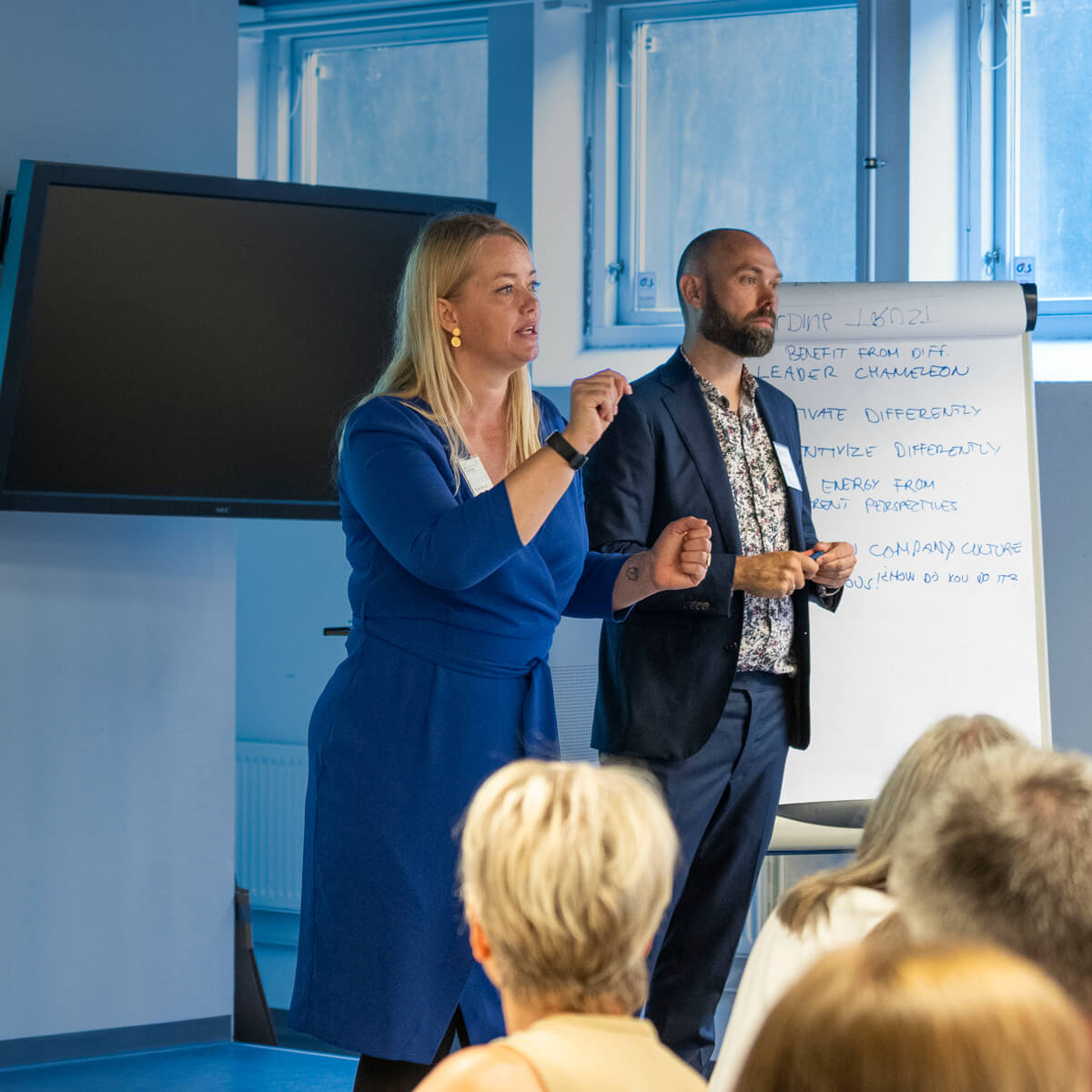
Signe og Mikkel, en del af Connecting Cultures
Inclusive language and communication

Create well-being for everyone with inclusive language and communication

Our unconscious bias is often reflected in the way we formulate ourselves – therefore, it is crucial to actively and consciously address our own language use if we want to promote an inclusive culture.

Diversity and inclusion: Inclusive Language and Communication

Inclusive communication in diverse teams

Being an inclusive communicator means expressing yourself in a way that makes everyone feel seen, heard, and valued – and invited into the dialogue on their own terms. This is especially important for employees who communicate or participate in ways that differ from the norm or the majority communication style.

In this course, we work purposefully with inclusive language and communication. This can relate to a wide range of preferences stemming from personality profiles, generational differences, gender, and more. In a global context, where colleagues have different cultural backgrounds, there will be variations in how direct communication is, how much nonverbal communication matters, and how to best create shared understanding.

In international organizations, the common working language—often English—plays a special role. Here, inclusive language also involves how and when we communicate in English, both verbally and in writing.

During the course, we co-create concrete guidelines and share practical tips on how to make your English more inclusive and accessible for everyone—in other words, how to improve what we call ‘global English’.

By the end of the course, you will be more aware of situations where your language may unintentionally exclude colleagues, and you will take away tools to communicate with a stronger focus on fostering psychological safety, well-being, and belonging for everyone, regardless of their background.
You should choose this training if

  • You want to challenge unconscious exclusionary language

  • You want to strengthen inclusion, well-being, and belonging by focusing on the role of language in collaboration

  • You work in an international or culturally diverse organization and want to improve your shared communication

  • You want to eliminate unconscious exclusionary language

  • You want to increase inclusion of diversity by focusing on language

Takeaways from the training

Specific knowledge about

  • How unconscious biases are expressed through language

  • The role of language as both an inclusive and exclusive mechanism

  • Inclusive English in an international context

  • How communication affects participation, psychological safety, and collaboration

  • The connection between inclusive language and belonging (sense of belonging)

  • Language as an active tool for inclusion

Competencies to

  • Recognize and change unconscious exclusionary language
  • Shift from unconsciously non-inclusive to consciously inclusive communication—both in writing and speech

  • Communicate more clearly and inclusively in English within an international work environment

  • Increase psychological safety and participation in decision-making and idea development through language adaptation

  • Become aware of, analyze, and adjust your own communication preferences, including verbal, nonverbal, oral, and written styles


Inclusive language and communication can be combined with inclusive leadership, collaboration in diverse teams, DE&I training, and unconscious bias training. We design a program tailored specifically to your needs.

Workshops, courses, lectures or one-to-one training?

We can advise you on the form that is most relevant to you.

Partners

Developing Inclusive Leaders

For nearly 15 years, we have been helping Danish and international companies increase cultural intelligence, develop inclusive leaders, and create a culture where everyone thrives and differences are used constructively.

See what our partners have to say about working with us on skills development and data collection and analysis.

Vores Diversitetskonsulenter samt lande- og kulturspecialister træner dig og dit team i inkluderende samarbejde og kulturel intelligens

Tak for en virkelig god og interessant eftermiddag. Vi fik nogle spændende samtaler i gang i vores team, som vi ellers ikke havde fået åbnet op for.

Sara Kristensen, Facility Trainee

LEGO